Associated Apparatus
Commonly referred to as 'the Barrier' it is traditionally a standalone device with input and output terminals, either a simple Zener Barrier or a more complex isolation interface. It can also be part of another assembly which is common on more complex devices such as multichannel I/O cards. All variations they all work on the same basic principle as a simple Zener barrier which is the easiest representation to demonstrate intrinsic safety principles
Zener Barrier
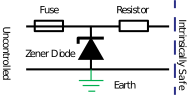 The Zener barrier limits the power to the field and preserve the integrity of the field equipment.
Key components are:
Zener Diode Limits the voltage within the intrinsically safe circuit.
Resistor1 - Limits the current going into the intrinsically safe circuit.
Fuse - limits the current to the Zener diode so in order to size it's power rating
The schematic for simplicity is an Ex ic Zener diodes would be duplicated for Ex ib triplicated for Ex ia to achieve the appropriate EPL.
Only a few Zener Barriers types are required to service most application loops and their simplicity makes them versatile in use.

Earthing
The Earth is critical for a Zener barrier, and there exists a lot of confusion and mis-information regarding Earthing, in most cases an 'intrinsic safety' earth is easy to achieve but may be an inconvenience.
As Isolation interfaces, where the cables are floating may require earthing for electrostatic discharge. This should not be confused with the 'intrinsic safety Earth'
Isolation Interface
 Isolation interface barriers seem to be the preferred choice for most applications other than some specific complex circuits.
In simple terms and isolation interface barrier is just a Zener barrier with electrical isolation between the hazardous and non‑hazardous area, consequently an intrinsic safety earth is not required as there is no direct electrical connection between the hazardous and non‑hazardous areas.
The 2-port can either be loop powered (as shown here) or have an additional power terminals.
The signal and power have a common connection, usually 0v.
 The 3-port isolation interface isolates signal, power and field terminals from each other.
This makes connecting devices in the non-hazardous area more flexible but can increase power dissipation and hence heat generation, as well as cost.
As Isolation interfaces are active rather than passive like Zener barriers, due to the complex nature of the circuitry they are generally designed for a specific purpose.
Note
-
In addition, Diode return barriers exist, they replace the Resistor with a Diode (or 3). Used for a return signal they allow a one-way signal input and do not contribute any current to the intrinsically safe circuit. ↩